
How Long Should a Pre-Shot Routine Be? A Simple 20-Second Framework
A golfer can look composed over one approach shot, then rush the next one after a poor drive. Two practice swings become none; a carefully chosen target becomes a vague glance towards the green. That changing preparation often invites second-guessing and too many swing thoughts.
A good pre-shot routine in golf is not about making each shot feel identical. It is a repeatable way to separate decisions from the swing itself. A simple four-step process can keep planning clear, reduce time spent standing over the ball and encourage a more committed strike across drives, approaches, chips and putts.
How Long Should a Pre-Shot Routine Be for Most Golf Shots?
For most golf shots, roughly 20 seconds is often used as a useful timing benchmark for a complete pre-shot routine. That time includes assessing the situation, choosing the shot, making one rehearsal and then executing; it is not 20 seconds spent frozen at address.
The value of the benchmark is consistency rather than speed. A routine that regularly takes 15 to 25 seconds can still serve its purpose if its order remains familiar. On a straightforward tee shot or putt, it may be shorter. A gusting wind, awkward ball lie or significant hazard carry may justify a little more time.
What tends to cause trouble is not a few extra seconds of sensible assessment, but indecision after the golfer has already approached the ball. Planning belongs behind the ball. Once the shot has been selected, the final phase should be brief and decisive.
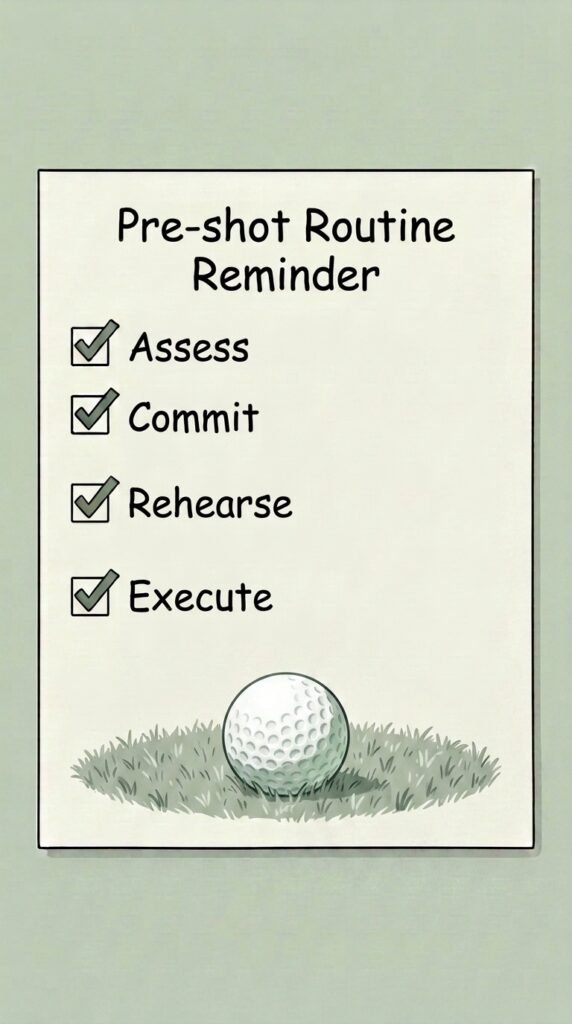
Save This Pre-shot Routine Reminder
Before you head to the first tee, take a few seconds to run through this simple reminder. It’s designed to highlight some pre-shot routine principles that can help golfers make clearer decisions and play with a more consistent strategy throughout the round.
What Is the Simple 20-Second Golf Pre-Shot Routine?
The simple 20-second routine is to Assess, Commit, Rehearse, and Execute. Each stage has a distinct job, which helps prevent club selection, target selection and swing mechanics from competing for attention at the same time.
Assess: Stand behind the ball and gather the relevant information: effective yardage, wind direction, ball lie, hazards, landing area and the preferable miss tendency. This is the planning stage, and it is also the sensible time to check a GPS device or rangefinder.
Commit: Choose a club and a precise aim point, then accept the decision. “Seven iron, back right” is clearer than simply aiming at the green. A defined target gives the swing a specific intention.
Rehearse: Make one practice swing that reflects the shot being pictured. It is a rehearsal, not a warm-up: the intended clubface delivery, shape where relevant and, above all, tempo should match the planned shot.
Execute: Approach the ball, settle into the setup, take one final look at the target and return the eyes to the ball. From address to swing, a 5–7-second execution window limits the opportunity for analysis paralysis.
What Should You Assess Behind the Ball Before Choosing a Shot?
Before choosing a shot, the golfer should assess the situation from behind the ball: distance, wind, lie, hazards, target and a sensible safe miss. This is where the plan is formed, before attention shifts to the act of swinging.
The details change by shot type, but the overall routine remains repeatable.
Drives: The landing area matters more than the flag. A golfer might consider the shape and width of the fairway, bunkers or penalty areas, wind direction and where a typical dispersion pattern is least damaging. The target may be a particular edge of a fairway or a distant tree, rather than the fairway in general.
Approach shots: Effective yardage includes more than the number to the pin. Wind, uphill or downhill ground, the ball lie, hazard carry and the best section of green can all affect club selection. A safe miss may be short of a front hazard or away from a bunker where recovery is difficult.
Chips and pitches: The key questions are often the lie, the amount of green available, the landing area and the likely rollout. A tight lie and a fluffy lie may invite different shot pictures even from similar distances.
Putts: Assessment shifts towards slope, pace and the intended start line. Looking from behind the ball can help identify an aim point, while views from the side may help a golfer judge the overall pace and break.
This does not require a lengthy inspection on every shot. It means collecting the information that genuinely affects the choice, then moving on rather than continuing to analyse while standing over the ball.
How Do You Commit, Rehearse and Execute Without Overthinking Your Golf Swing?
Commitment comes from making the decisions before the swing, rehearsing one clear intention, then allowing the execution phase to stay simple. The aim is not to eliminate all uncertainty from golf; it is to avoid carrying unresolved decisions into the address position.
Once the club and target are chosen, a useful rule is to avoid altering either while in the routine. If doubt remains—perhaps the wind has changed or the club selection no longer feels right—the better reset protocol is to step away, reassess and make a fresh decision. Changing from a six iron to a seven iron in the final seconds, or shifting from the left side of a green to the right, can leave the swing caught between two plans.
One intentional practice swing is usually enough to rehearse the planned motion and tempo cue. It should be made with the target picture in mind, rather than being a disconnected movement beside the ball. If that rehearsal feels poor, stepping back and resetting preserves the same planning–execution separation; hoping the real swing will somehow correct an abandoned rehearsal often adds doubt.
At the ball, the attentional focus narrows. One look towards the target, eyes back to the ball, then the swing within about 5–7 seconds is the basic sequence. A simple cue such as “smooth” or a sense of rhythm may fit this stage. Detailed swing mechanics, clubface positions and technical corrections generally belong away from the moment of execution.
When Should You Take Longer Than 20 Seconds for a Pre-Shot Routine?
A pre-shot routine may take longer than 20 seconds when new information genuinely changes the shot, but the extra time is best used to reassess rather than to linger over the ball. The timing benchmark is a guardrail against unnecessary delay, not a rule that ignores the situation.
A longer routine can be reasonable in a few circumstances:
A changing condition: A fresh gust, altered wind direction or a delay that changes the feel of the shot can justify another look from behind the ball.
An unusual lie or high-consequence choice: A ball sitting down in rough, on a severe slope or near trouble may require a more careful decision about club selection, landing area and safe miss.
A physical setup requirement: Uneven ground, a plugged lie or a stance restricted by a tree can take extra time to set up safely and comfortably.
A disruption to the routine: If a golfer is distracted, loses the target picture or notices that doubt has taken over, stepping back offers a cleaner restart than trying to repair the plan at address.
Extra practice swings are less useful when they simply repeat the same movement without a clearer intention. One rehearsal may be enough for an ordinary shot. A second can make sense when it helps a golfer feel an unfamiliar lie, slope or required length of swing, but it should still relate to the shot rather than become a delay habit. Pace of play also matters: thoughtful preparation can be completed while others are playing or before it is a golfer’s turn, where appropriate. The USGA recommends that players take up to 40 seconds per stroke as a prompt pace-of-play guideline.
How Can You Build a Solid Pre-Shot Routine That Holds Up After Bad Shots?
A solid routine is built by practising the same sequence until it feels familiar after both good and bad shots. The aim is not to make golf predictable; it is to give the golfer a reliable process when the previous result creates frustration or urgency.
Rehearse it on the driving range: One way golfers build consistency is by using the same sequence on the driving range before every ball, rather than hitting several balls in a row from the same spot. Pick a target, assess the imagined conditions, choose a club, rehearse once and execute. This makes range practice more like golf on the course.
Use it on the practice green: Apply the same order to putts: read the slope and pace, select an aim point, make one purposeful rehearsal and roll the putt without a long pause over the ball. The details differ, but the routine remains recognisable.
Time the process occasionally: A phone timer or a playing partner’s informal observation can show whether the routine is drifting into lengthy analysis. Around 20 seconds is a practical reference, not a test to pass exactly.
Choose one execution cue: A single tempo cue or feel, such as “smooth”, is easier to carry into the swing than a list of swing thoughts. The cue should be used only after the planning is complete.
Reset after a poor shot: A bad result is information about the last shot, not a reason to abandon the next routine. Walking to the next ball can be used to let the reaction settle. Then the next shot begins again behind the ball with a new assessment.
Reset after a poor rehearsal: If the practice swing does not match the intended tempo or picture, step away and restart the process. That small pause is different from standing over the ball and trying to solve several problems at once.
Conclusion
The best length for a pre-shot routine is long enough to make a clear decision and short enough to preserve commitment. Assessing the situation, committing to a specific club and target, rehearsing once, and executing promptly creates a repeatable bridge between course management and the swing. Whether the shot is a drive, an approach, a chip, or a putt, the same basic order can make preparation calmer and more consistent.
This article and video are intended as general golf strategy education and commentary for a broad audience. They are not personalised golf instruction or coaching, and readers should decide for themselves whether and how these ideas apply to their own game.