Course Management in Golf: 5 Common Mistakes You May Be Making
If you’ve ever walked off the 18th green wondering how you managed to shoot another disappointing score despite hitting plenty of good shots, you’re not alone.
Most golfers assume they need a better swing to lower their scores, but that’s often only part of the story. The decisions golfers make before each shot can have a significant impact on your score, even without changing your swing.
Choosing the right target, knowing when to play aggressively and when to take the safer option, and thinking one shot ahead are all part of good course management.
In this guide, we’ll look at five common course management mistakes that quietly add strokes to your round. Alongside the video below, you’ll learn simple changes that can help you make smarter decisions, avoid unnecessary trouble, and give yourself more opportunities to score well without changing your golf swing.
Why Is Course Management So Important in Golf?
Course management is important because the decisions you make before each shot often have a greater impact on your score than the quality of your swing.
Every golfer faces choices around the course, from club selection and target lines to deciding when to play aggressively or take the safer option. Good golf course management means making decisions that match your ability instead of attempting low-percentage shots that can quickly lead to penalty strokes or difficult recoveries. You don’t need to hit every shot perfectly to score well. By aiming away from trouble, playing to your strengths, and thinking one shot ahead, you give yourself more chances to make pars and bogeys while avoiding the double bogeys that ruin scorecards.
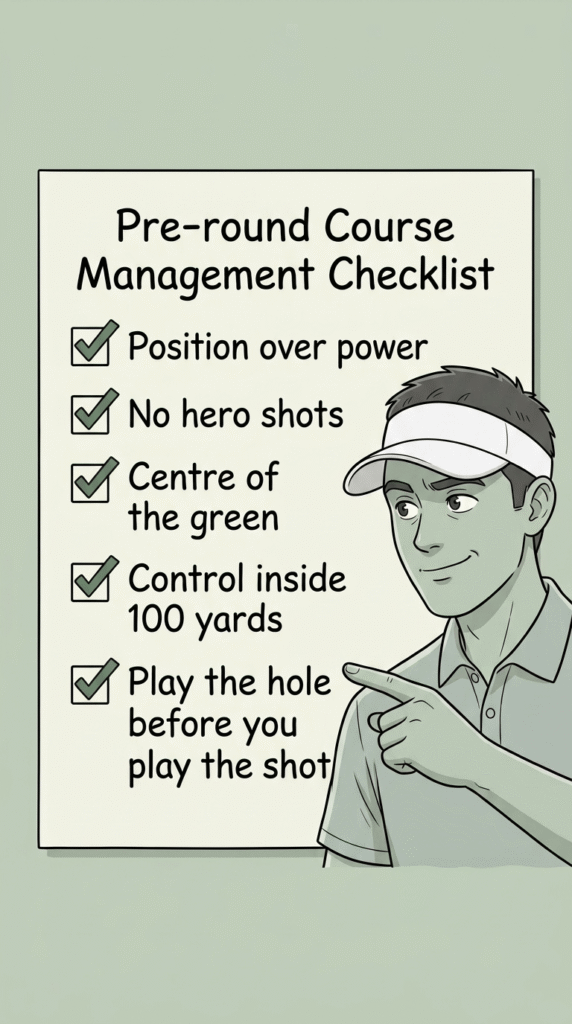
Save This Pre-Round Checklist
Before you head to the first tee, take a few seconds to run through this simple checklist. It’s designed to remind you of the key course management decisions that can help you avoid unnecessary mistakes and score more consistently throughout your round.
Are You Making the Wrong Club Selection Before You Even Swing?
Yes, you may be making the wrong club selection if you choose a club based on your best-ever shot instead of the distance you normally hit it.
One of the biggest course management mistakes is picking a club for the perfect outcome rather than the most likely one. Most golfers remember the one time they hit their 7-iron 160 yards and forget that their average carry is much shorter. Good club selection often starts with knowing your typical distances and then adjusting for the conditions. Wind direction, uphill lies and downhill lies, hazards, and the location of the pin can all influence which club gives you the best chance of success. In many situations, choosing the safer club and aiming for the largest part of the green is more likely to save strokes than trying to hit the perfect shot.
Key Club Selection Mistakes to Avoid
- Choosing clubs based on your best shot – Select a club using your average carry distance, not the longest shot you’ve ever hit.
- Ignoring the conditions – Consider the wind, elevation, temperature and lie before making your final decision.
- Overlooking hazards – Don’t choose a club that brings bunkers, water or other trouble into play if a safer option is available.
- Only thinking about the flag – Focus on where you want the ball to finish, not just the pin location.
- Trying to force the perfect shot – A smart, conservative choice will usually lead to lower scores over time than chasing difficult shots with little margin for error.
Should You Always Be Aiming at the Flag?
No. You should not always aim at the flag because the safest target often gives you the best chance of making a good score.
Many golfers instinctively fire at every pin, but that approach can quickly lead to unnecessary mistakes. When the flag is tucked close to a bunker, water or the edge of the green, your margin for error becomes much smaller. A common course-management approach is aiming towards the centre of the green whenever the risk outweighs the reward. Even if your shot isn’t perfect, you’re far more likely to finish on the putting surface with a realistic chance at par and less risk of a costly recovery shot. Good course management is about choosing targets that match your ability, not your ambition. Over time, disciplined targeting reduces costly misses and helps you build more consistent scores without needing to hit every approach shot perfectly.
Is Your Tee Shot Setting Up the Rest of the Hole?
Yes. A good tee shot is one that leaves you in the best position for your next shot, not necessarily the longest one.
Many golfers automatically reach for the driver on every par 4 or par 5, but extra distance is only helpful if the ball stays in play. Before you choose a club, look at where the trouble is. Fairway bunkers, penalty areas, trees and narrow landing areas can quickly turn an easy hole into a difficult one. If a fairway wood or hybrid genuinely gives you a better chance of keeping the ball in play on a specific hole, giving up some distance can be worth it. However, shot-tracking data suggests that many amateurs are not significantly more accurate with a 3-wood than with a driver, so this is worth testing with your own game rather than assuming a shorter club will always be safer.
Good course management starts by thinking one shot ahead. Ask yourself where you want to play your approach from and which club gives you the best chance of getting there. A tee shot that finishes in the fairway with a clear view of the green will usually lead to a better scoring opportunity than a longer drive that leaves you blocked by trees or playing from deep rough.
Are You Losing Strokes Around the Green Without Realising It?
Yes. You could be losing strokes around the green if you’re choosing the most difficult shot instead of the simplest one.
The short game isn’t just about technique. It’s about making smart decisions. Before reaching for your wedge, consider whether a putter or a simple chip would get the ball closer to the hole with less risk. When you do need to play a recovery shot, choose the option that gives you the highest chance of getting back into position rather than attempting a low-percentage shot that could leave you in even more trouble. Before attempting the shot, ask yourself how often you would actually pull it off. If the success rate is low, take your medicine, return to the fairway, and give yourself a chance to save bogey instead of risking double or triple bogey.
Golf course management around the green is about picking the shot you can execute consistently, not the one that looks the most impressive.
This article and video are intended as general golf strategy education and commentary for a broad audience. They are not personalised golf instruction or coaching, and readers should decide for themselves whether and how these ideas apply to their own game.